
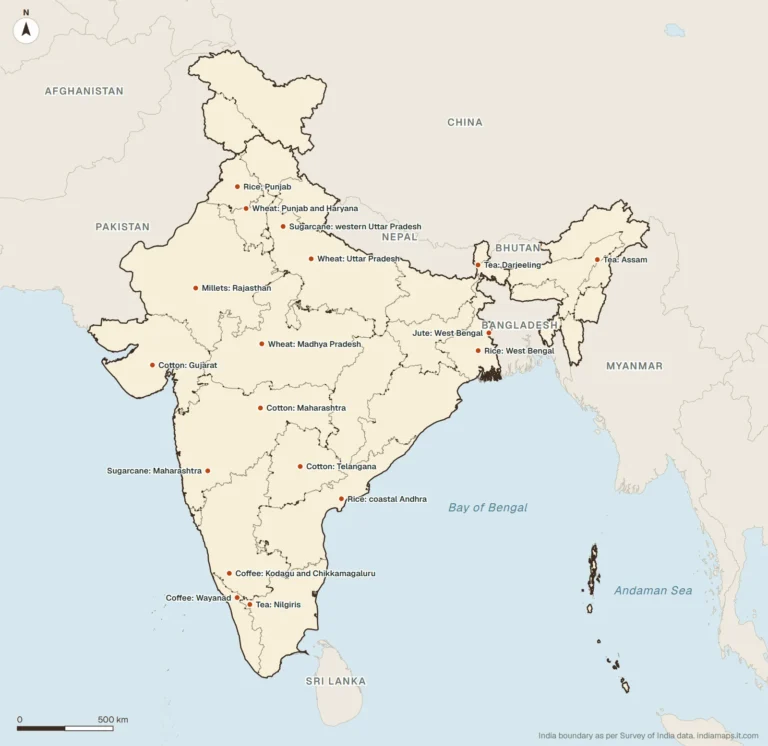
This crop map of India marks the main growing areas of eight major crops: rice, wheat, tea, coffee, cotton, jute, sugarcane and millets. Rice fills the wet east and the canal lands of Punjab, wheat fills the northern plains, tea climbs the hills of Assam, Darjeeling and the Nilgiris, and coffee grows on the shady slopes of Karnataka and Kerala.
Each crop picks its place by rain, temperature and soil. Read the map beside a rainfall map and a soil map and most of the pattern explains itself. The tables below give the leading areas, the season and the soil for each crop.
At a glance
Crops marked
Rice, wheat, tea, coffee, cotton, jute, sugarcane, milletsTop rice state
West BengalTop wheat state
Uttar PradeshTop tea state
AssamTop coffee state
KarnatakaCrop seasons
Kharif (monsoon), rabi (winter), zaid (summer)
Crop map of India: the eighteen marked areas
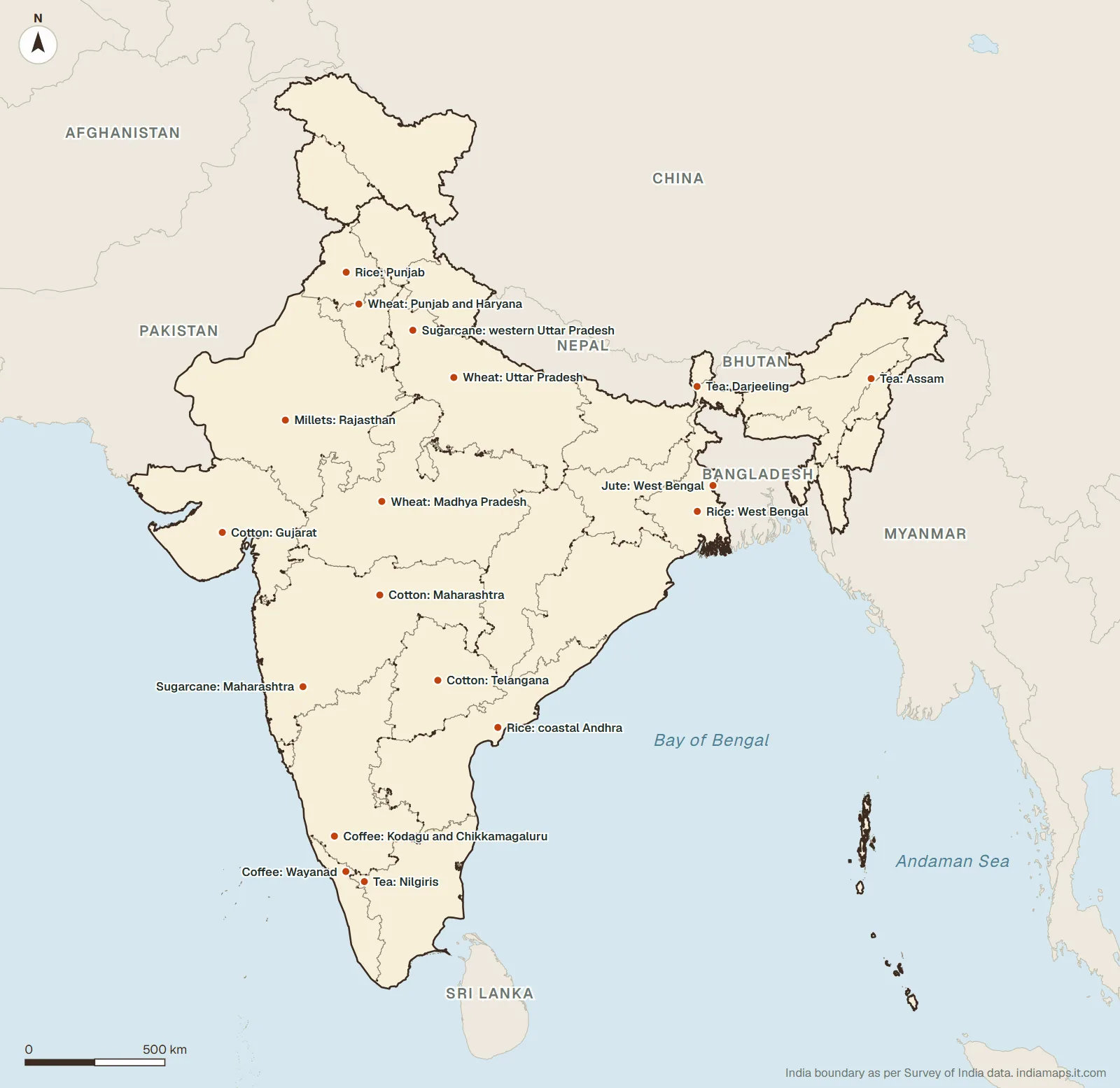
Every label starts with the crop name and then the area, such as Tea: Assam or Coffee: Wayanad. Look for crops that appear more than once. Rice shows up in three places, wheat in three, tea in three, cotton in three, coffee and sugarcane in two each. Once you have a printed copy, give every crop its own colour or symbol. More such maps are on the thematic map of India page.
Major crops grown in India map, crop by crop
| Crop | Areas on the map | Season |
|---|---|---|
| Rice | West Bengal, Punjab, coastal Andhra | Kharif |
| Wheat | Uttar Pradesh, Punjab and Haryana, Madhya Pradesh | Rabi |
| Tea | Assam, Darjeeling, Nilgiris | All year in the hills |
| Coffee | Kodagu and Chikkamagaluru, Wayanad | All year on shaded slopes |
| Cotton | Gujarat, Maharashtra, Telangana | Kharif |
| Jute | West Bengal | Kharif |
| Sugarcane | Western Uttar Pradesh, Maharashtra | Grows about a year |
| Millets | Rajasthan | Kharif |
Food grains: rice, wheat and millets
Rice needs high heat and a lot of water, more than 100 cm of rain or steady canal water. It grows best in the deltas of the east and on the coasts. Punjab and Haryana grow it too, but with canals and tube wells rather than rain.
Wheat is a winter crop. It likes cool, moist weather while growing and bright sun at harvest. The fertile plains of the Ganga and its tributaries and the black soil of Madhya Pradesh suit it well.
Millets such as bajra, jowar and ragi grow in dry areas with poor soil. Rajasthan leads in bajra, and the dry Deccan grows jowar and ragi. Check rainfall on the climate map of India.
Coffee growing area in India map
Coffee grows on the hill slopes of the Western Ghats, under the shade of tall trees. Karnataka produces most of India's coffee, mainly in Kodagu, Chikkamagaluru and Hassan. Kerala comes next, with Wayanad as the main district, and Tamil Nadu grows some in the Nilgiris and nearby hills.
To mark the coffee growing area, shade the hills of south western Karnataka inland from Mangaluru, then add a patch on the Kerala side just south of it for Wayanad. Coffee from these hills is shipped through the ports on the ports in India map.
Tea, cotton, jute and sugarcane
- Tea: needs warm weather, rain spread through the year and well drained slopes, so water does not stand at the roots. Assam grows the most, followed by West Bengal, where Darjeeling tea is famous. In the south, the Nilgiris are the main area.
- Cotton: loves the black soil of the Deccan lava plateau, with light rain and plenty of sunshine. Gujarat and Maharashtra lead, and Telangana is close behind.
- Jute: called the golden fibre, it needs hot, wet weather and the fresh silt of flood plains. West Bengal grows most of it in the Ganga delta.
- Sugarcane: needs heat, water and a long season. Western Uttar Pradesh grows the most, while Maharashtra gets high yields from irrigated land.
The factories that use cotton and jute appear on the industries in India map.
Soils behind the crops
| Soil | Crops it suits |
|---|---|
| Alluvial | Rice, wheat, sugarcane, jute |
| Black | Cotton, also jowar and soybean |
| Red and yellow | Millets, pulses, groundnut |
| Laterite on hill slopes | Tea, coffee, cashew |
| Sandy desert | Bajra and other hardy crops |
See each of these zones on the soil map of India.
Marking major crops of India map in an exam
- Read the question carefully: it may ask for the leading state, or simply an area where the crop grows.
- Use a symbol for each crop and draw a small key.
- Shade areas, not single dots, because crops cover large regions.
- Put tea in the hills: upper Assam, the Darjeeling hills and the Nilgiris. Never put tea on the plains of Punjab.
- Put coffee only in the far south west hills.
Frequently asked questions
Which state produces the most rice in India?
West Bengal is usually the top rice producer, with Uttar Pradesh and Punjab close behind. The order can change a little from season to season.
Where is the coffee growing area in India map?
Coffee grows in the Western Ghats of Karnataka, Kerala and Tamil Nadu. Kodagu and Chikkamagaluru in Karnataka and Wayanad in Kerala are the main districts.
Which state is the largest producer of tea?
Assam produces the most tea in India. West Bengal, with the Darjeeling and Dooars gardens, comes second.
What are kharif and rabi crops?
Kharif crops are sown with the monsoon rains and cut in autumn; rice, cotton, jute and millets are examples. Rabi crops are sown in winter and harvested in spring; wheat, gram and mustard are examples.
Why does cotton grow on black soil?
Black soil keeps water in for weeks after the rain stops and is rich in lime and potash. Cotton has deep roots and needs that steady moisture with plenty of sunshine.
Which crop is called the golden fibre?
Jute is called the golden fibre because of its shiny golden colour and its value. West Bengal grows most of India's jute.