
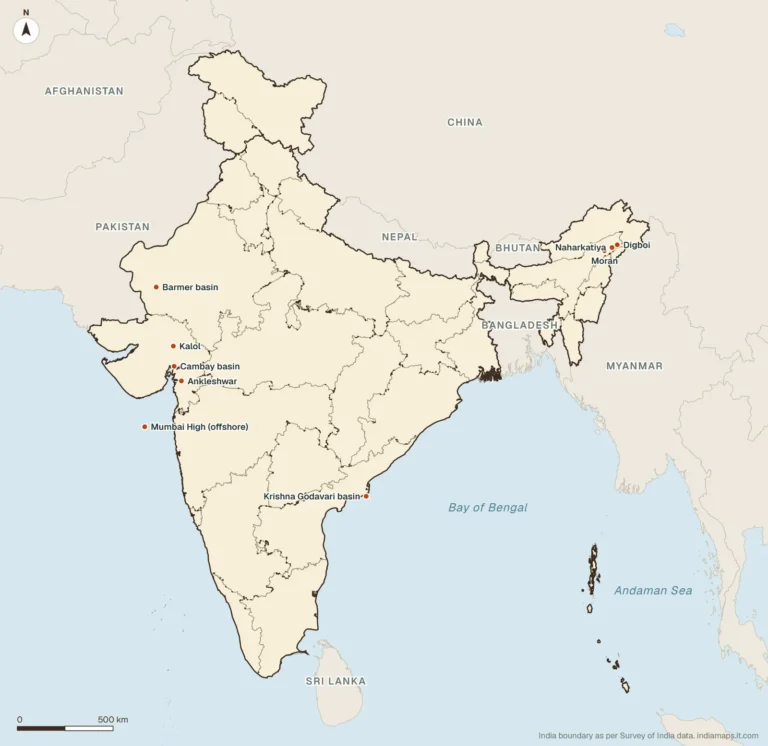
This oil fields in India map shows the places where crude oil is taken out of the ground or the sea bed: the old fields of upper Assam, the Cambay basin of Gujarat, the offshore Mumbai High field in the Arabian Sea, the Barmer basin of Rajasthan and the Krishna Godavari basin on the Andhra coast.
Oil forms in thick layers of sedimentary rock, so you will not find it on the old hard rocks of the Deccan plateau. That one idea explains almost the whole pattern on the map. Below are the fields state by state, a note on refineries, and a neat routine for plotting each field yourself.
At a glance
Oldest field
Digboi, Tinsukia district, AssamBiggest producer
Mumbai High, offshore in the Arabian SeaMain onshore areas
Upper Assam, Gujarat, Barmer in RajasthanMain offshore areas
Mumbai High, Krishna Godavari basinRock type
Sedimentary basins, not the Deccan lavaImports
Most crude oil used in India is bought from abroad
Oil fields in India map: the marked places
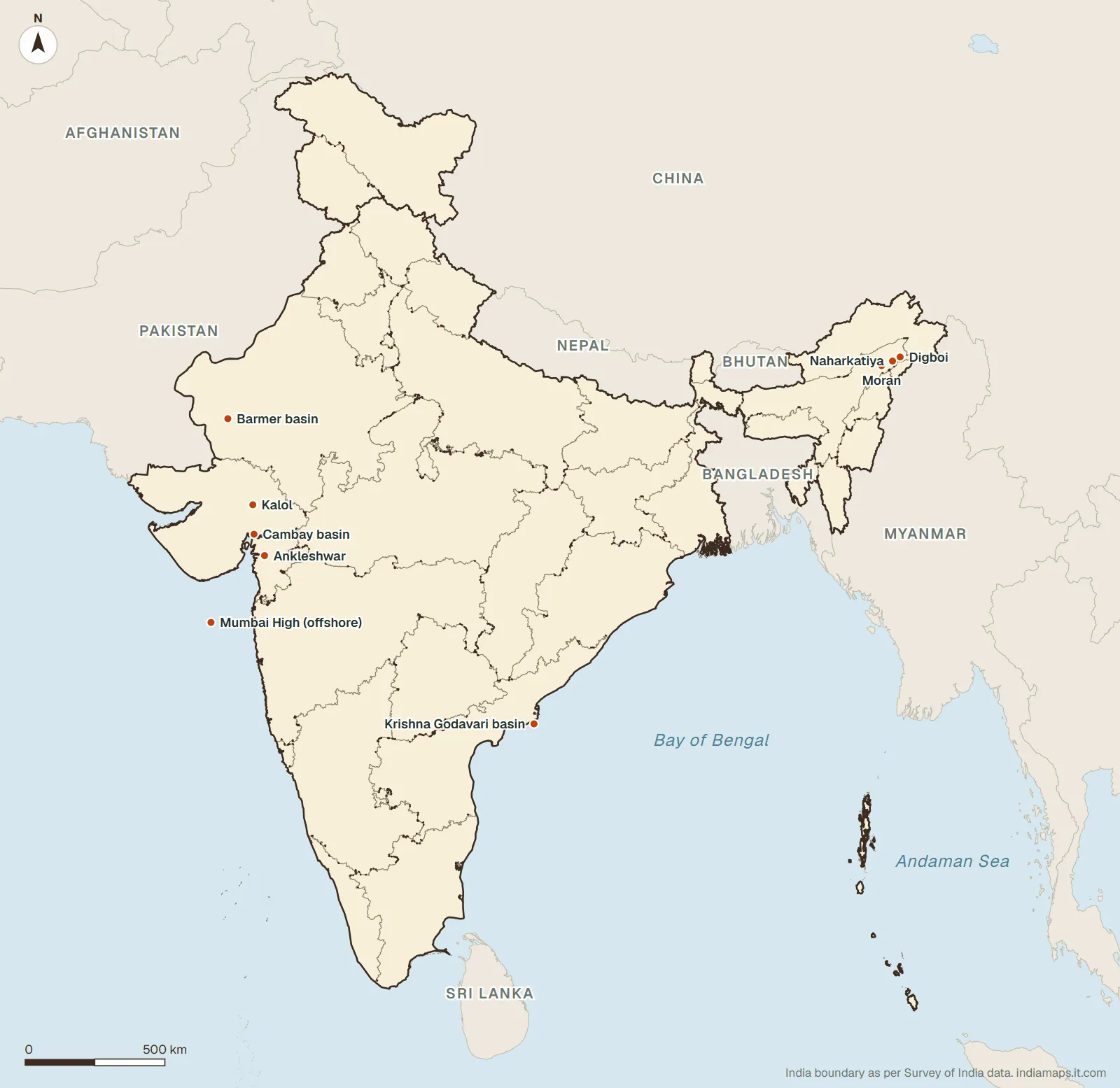
Nine places are marked. Three cluster in the far north east, in the Brahmaputra valley. One sits out at sea off Maharashtra. Three more lie around the Gulf of Khambhat in Gujarat, one is in the western desert of Rajasthan and one hugs the Andhra coast where two big rivers meet the Bay of Bengal. The download buttons give you this sheet as a picture file or an A4 page.
Petroleum in India map, region by region
| Area | State or sea | Fields to name |
|---|---|---|
| Upper Assam | Assam | Digboi, Naharkatiya, Moran |
| Mumbai High | Arabian Sea, off Maharashtra | Mumbai High (also called Bombay High), Bassein nearby |
| Cambay basin | Gujarat | Ankleshwar, Kalol, fields around Khambhat |
| Barmer basin | Rajasthan | Large onshore fields in the Thar |
| Krishna Godavari basin | Andhra Pradesh coast and sea bed | Oil and a great deal of natural gas |
Look at how these areas sit on low plains, deltas and the sea floor. Compare them with the hills and plateaus of the physical map of India.
Digboi in India map
Digboi is a small town in the Tinsukia district of Assam, near the eastern end of the state and not far from Arunachal Pradesh. It is the oldest oil field in India, and its refinery is the oldest one still working in the country. People often call it the oil city of Assam.
To mark it, follow the Brahmaputra upstream to the point where the valley narrows in the far east of Assam. Put your dot just south of the river there. Naharkatiya and Moran lie a little to the south west of Digboi, in the Dibrugarh district.
Mumbai High in India map (Bombay High)
Mumbai High is an offshore field on the continental shelf in the Arabian Sea, well over 150 km west of the city of Mumbai. Oil and gas are pumped from platforms standing in the sea and sent to the shore by pipelines under the water. It is the largest single producer of crude oil in India.
When older books show Bombay High in India map exercises, they mean this same field, named after the old name of the city. On a map, never put it on land. Draw a small platform symbol in the sea, west and slightly north of Mumbai, and label it in the water.
Gujarat and Rajasthan fields
Gujarat is one of the oldest oil states after Assam. Ankleshwar lies in the Bharuch district, close to the Narmada. Kalol lies near Ahmedabad and Gandhinagar. Both belong to the Cambay basin, a long trough of soft rock under the Gulf of Khambhat and the plains around it.
Further north, the Barmer basin in western Rajasthan is a newer find. Big onshore fields there pump crude from under the sands of the Thar. Locate the district on the India map with states before you mark it.
From oil field to refinery
Crude oil is of little use until a refinery splits it into petrol, diesel, kerosene, cooking gas and many other products. Some refineries stand beside the fields, such as Digboi, Guwahati and Numaligarh in Assam and Koyali near Vadodara. Others stand at the coast, close to the ports where imported crude arrives: Jamnagar, Mumbai, Kochi, Chennai, Visakhapatnam and Paradip.
Find these harbours on the ports in India map, and see the factories that use oil products on the industries in India map.
Why there is no oil on the Deccan
Oil comes from tiny sea plants and animals that were buried in mud on old sea beds. Over a very long time heat and pressure turned them into oil, which collects in porous rock under a cap of hard rock. Such layers exist in river deltas, coastal plains and shallow seas. The Deccan plateau is made of hard volcanic and crystalline rock, so it has none. This is a good point to write in an answer about the location of oil fields.
Steps to mark oil fields on an outline map
- Mark the three Assam fields first, in the narrow eastern tip of the Brahmaputra valley.
- Draw Mumbai High in the sea, off the Maharashtra coast.
- In Gujarat put Kalol near Ahmedabad and Ankleshwar further south, near the mouth of the Narmada.
- Shade a small area in western Rajasthan for Barmer.
- Shade the Krishna Godavari delta and the sea in front of it.
- Add a key that says oil field, and label each name neatly.
More resource maps are listed on the thematic map of India page.
Frequently asked questions
Where is Digboi in India map?
Digboi is in the Tinsukia district of upper Assam, in the far east of the Brahmaputra valley. It is the oldest oil field in India and has the oldest working refinery.
Where is Mumbai High in India map?
Mumbai High lies in the Arabian Sea, well over 150 km west of Mumbai, on the continental shelf. It is an offshore field, so it must be marked in the sea and not on land.
Is Bombay High the same as Mumbai High?
Yes. Bombay High is the older name, taken from the earlier name of the city. Both names mean the same offshore oil field.
Which state has the oldest oil fields in India?
Assam. Digboi, Naharkatiya and Moran in the upper Brahmaputra valley are the oldest fields. Gujarat came next with Ankleshwar and Kalol.
Why are oil fields found near coasts and deltas?
Oil forms in thick sedimentary rock laid down in old seas and river deltas. Coastal plains, deltas and the shallow continental shelf have such rock, while the Deccan plateau does not.
Does India produce all the oil it needs?
No. Indian fields meet only a small part of the demand, and most crude oil is imported by sea. That is why many large refineries are built at the coast.